Power fails. Networks drop. The system keeps working.
Four stages, each one simple. Built for Nigerian field conditions: no grid power, patchy internet, real dust, real rain.
1. Sensors in the soil
Rugged probes measure soil moisture, temperature, and conductivity every few minutes. They run for years on one battery and talk to the gateway by radio, two to eight kilometres line of sight. No SIM cards. No wifi. No power lines in the field.
2. The gateway hears them
One gateway covers a whole pilot cluster. Off-grid is normal: a small solar kit runs it. When internet is available it forwards data. When it isn't, readings queue on site and sync later. We forced the outage ten times and all ten replayed in order.
3. Your own computer keeps the records
A box the size of a paperback on your premises stores every reading, backs itself up nightly, and enforces memory limits so it behaves for years. It passed 9 out of 9 minimum-spec checks on a $60-class board — while sharing that board with ten other services.
4. You read answers, not dashboards
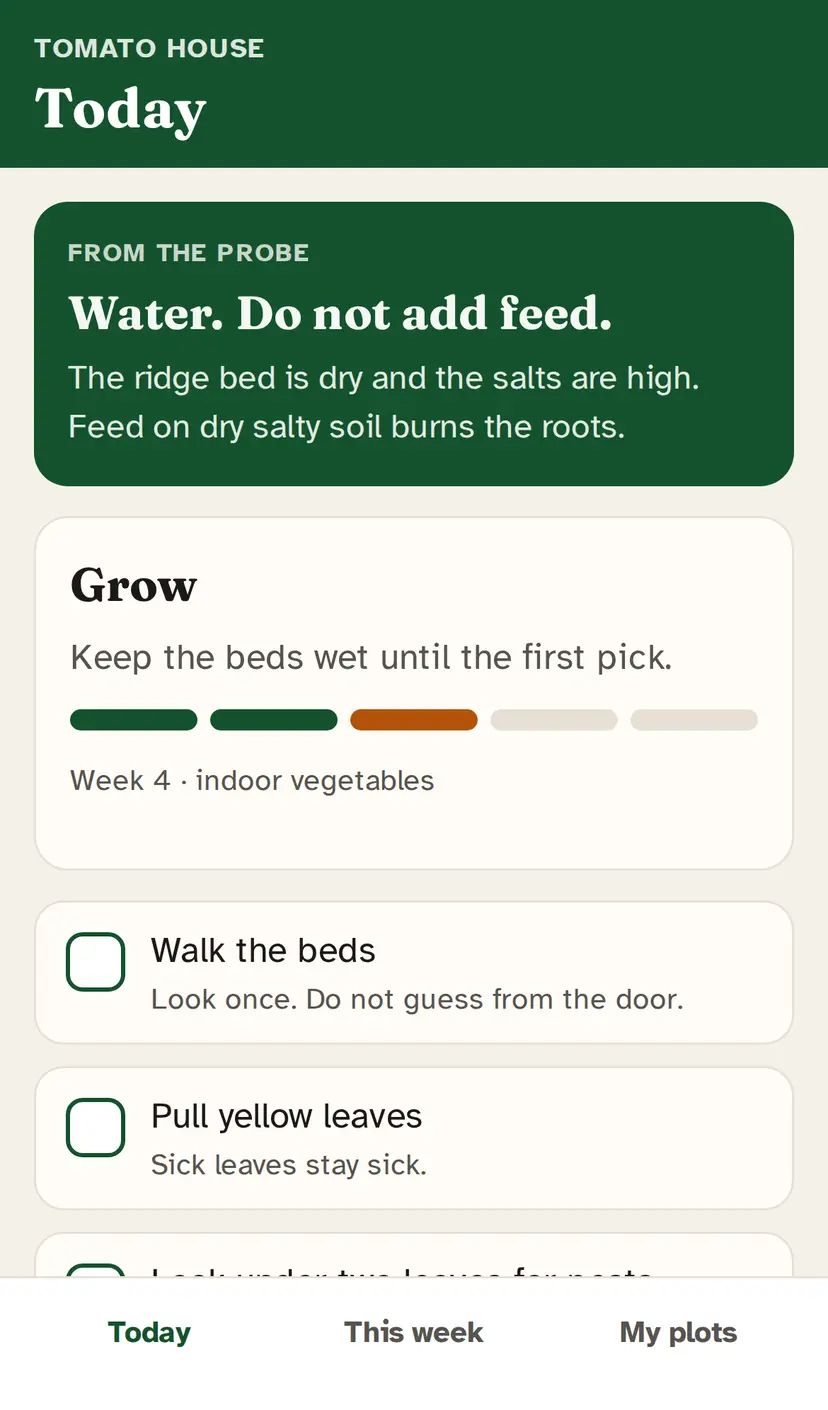
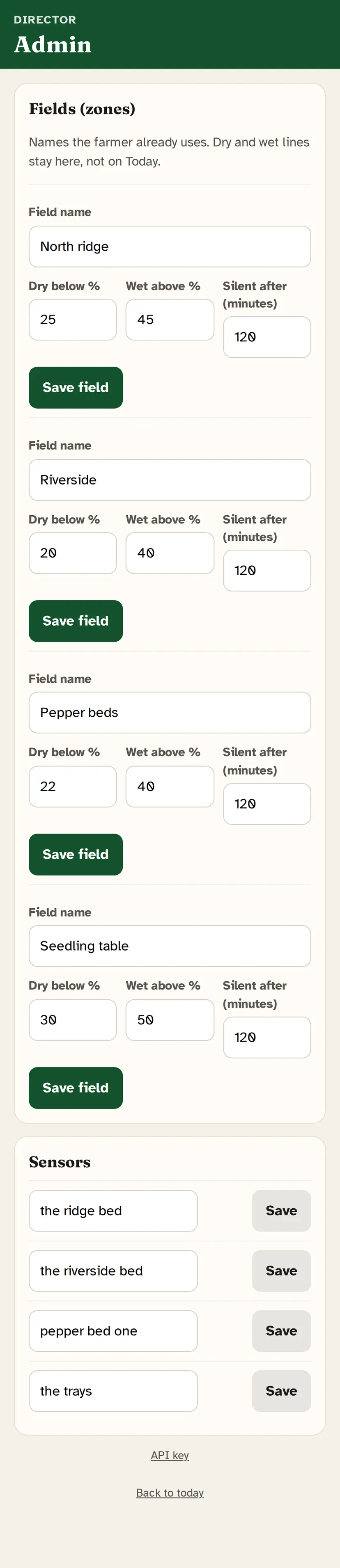
Open Today. One plot. The stage of the season. A list you tap. If the probe sees dry soil and high salts together, the phone says water, and do not add feed. Quiet probe means walk there. Percentages stay with the director.
Then it still works. The probes, the gateway and the computer that keeps your records are all on your land, talking to each other over radio and a cable. Nothing in that chain calls out. You walk into the office, open the app, and the numbers are there.
Internet is only for looking at your farm when you are not on it, and for us to help you without driving down. That is a tiny amount of traffic: your app pulls about 240 bytes to refresh, and a day's chart is under 2 KB. A whole month of checking comes to less than half a megabyte. A ₦1,000 phone bundle in a small router covers it several times over, and if your signal is weak an aimed antenna will usually find a mast ten kilometres away.
If anyone tells you a farm like yours needs a ₦57,000 satellite dish to monitor soil, they are selling you a dish. We will quote you the router.
Why self-hosted?
Because your season's data is worth more than the sensors.
You own the data
Your season books live on your hardware. No vendor can lock them, sell them, or switch them off.
No subscription to exist
The system runs because the hardware runs. Support is a choice, not a ransom.
Built for the field
Store-and-forward design means poor internet is an inconvenience, not a failure mode.